Indications - Symptomatic treatment of urge incontinence and/or increased urinary frequency and urgency as may occur in patients with overactive bladder syndrome.
Dosage & Administration - The recommended dose for adults and the elderly: Solifenacin Succinate 5 mg once daily. If needed, the dose may be increased to Solifenacin Succinate 10 mg once daily. Use in children: Safety and effectiveness in children have not yet been established. Therefore, Solifenacin Succinate should not be used in children.
Side Effects - Due to the pharmacological effect of Solifenacin, it may cause anticholinergic undesirable effects of (in general) mild or moderate severity. The frequency of anticholinergic undesirable effects is dose related. The most commonly reported adverse reactionwith Solifenacin is dry mouth. It occurred in 11% of patients treated with 5 mg once daily, in 22% of patients treated with 10 mg once daily and in 4% of placebo-treated patients. The severity of dry mouth was generally mild and only occasionally led to discontinuation of treatment. In general,medicinal product compliance was very high (approximately 99%) and approximately 90% of the patients treated with Solifenacin completed the full study period of 12 weeks treatment. Gastrointestinal disorders: very common- dry mouth, common-constipation, nausea, dyspepsia, abdominal pain, uncommon- gastroesophageal reflux diseases, dry throat, rare- colonic obstruction, faecal impaction, very rare- vomiting. Infections and infestations: uncommonurinary tract infection, cystitis. nervous system disorders: uncommon- somnolence, dysgeusia, very rare-dizziness, headache. psychiatric disorders: very rare- hallucinations. eye disorders: common- blurred vision, uncommon- dry eyes. General disorders and administration site conditions: uncommon- fatigue, peripheral oedema. Respiratory, thoracic and mediastinal disorders: uncommon nasal dryness. skin and subcutaneous tissue disorders: uncommon- dry skin, very rare- pruritus, rash, urticaria. renal and urinary disorders: uncommon- difficulty in micturition, rare- urinary retention.
Contraindications - Solifenacin is contraindicated in patients with hypersensitivity to solifenacin or to any of the excipients. It is also contraindicated in myasthenia gravis, urinary retention, uncontrolled narrow angle glaucoma, severe gastro-intestinal condition (including toxic megacolon), patients undergoing haemodialysis, patients with severe hepatic impairment, patients with severe renal impairment or moderate hepatic impairment and on treatment with a strong CYP3A4 inhibitor, e.g. ketoconazole.
Others - Pregnancy & Lactation No clinical data are available from women who became pregnant while taking Solifenacin. Animal studies do not indicate direct harmful effects on fertility, embryonal / foetal development or parturition. The potential risk for humans is unknown. Caution should be exercised when prescribing to pregnant women. No data on the excretion of Solifenacin in human milk are available. In mice, Solifenacin and/or its metabolites was excreted in milk, and caused a dose dependent failure to thrive in neonatal mice. The use of Solifenacin should therefore be avoided during breast-feeding.
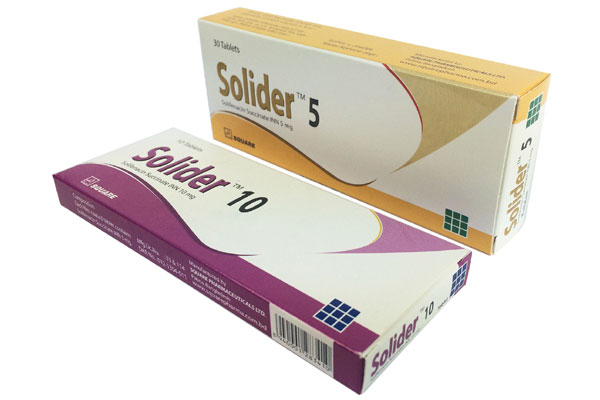
Tablet Solider 10 mg
- Brand Name - Solider 10 Tablet
- Generic Name - Solifenacin Succinate
- Doges From - Tablet
- Strength - 10 mg
- Pack Size - 10s
- Manufacture - Square Pharmaceutical Ltd.
Customers who bought this item also bought