
Indications - Treatment of painful muscle spasms: Associated with static and functional disorders of the spine (cervical and lumbar syndromes). Following surgery, e.g. for herniated intervertebral disc or osteoarthritis of the hip. Treatment of spasticity due to neurological disorders: Multiple sclerosis, chronic myelopathy, degenerative spinal cord diseases, cerebrovascular accidents, and cerebral palsy.
Dosage & Administration - Tizanidine has a narrow therapeutic index and high inter-patient variability in tizanidine plasma concentrations which requires individualized dose adjustment. A low starting dose of 2 mg three times daily can minimize the risk for adverse effects. The dose should be carefully adjusted upward according to the needs of the individual patient. Relief of painful muscle spasms: The usual dose is 2 to 4 mg three times daily in tablet form. In severe cases, an extra dose of 2 or 4 mg may be taken, preferably at night to minimize sedation. Spasticity due to neurological disorders: The initial daily dose should not exceed 6 mg given in 3 divided doses. It may be increased stepwise at half-weekly or weekly intervals by 2 to 4 mg. The optimum therapeutic response is generally achieved with a daily dose of between 12 and 24 mg, administered in 3 or 4 equally spaced doses. The daily dose of 36 mg should not be exceeded. Pediatrics patients: Experience in patients below 18 years of age is limited and the use of Tizanidine in this population is not recommended. Geriatric patients (65 years of age or older): Experience with the use of Tizanidine in the elderly is limited. Therefore, it is recommended to start treatment at the lowest dose and increases should be done in small steps according to tolerability and efficacy. Renal impairment: In patients with renal impairment (creatinine clearance <25 mL/min), it is recommended to start treatment at 2 mg once daily. An increase in dosage should be done in small steps according to tolerability and efficacy. If efficacy has to be improved, it is advisable to first increase the strength of the daily dose before increasing the frequency of administration. Hepatic impairment: Use of Tizanidine in patients with severe hepatic impairment is contraindicated. While Tizanidine is extensively metabolized in the liver, limited data are available in this population. Its use has been associated with a reversible abnormality in liver function tests. Tizanidine should be used with caution in patients with moderate hepatic impairment and treatment should be started with the lowest dose. Afterward, an increase in dosage should be done carefully and according to patient tolerability. Discontinuation of treatment: If Tizanidine has to be discontinued, the dosage should be slowly down titrated, particularly in patients who have received high doses for a longer period of time to avoid or minimize the risk of rebound hypertension and tachycardia.
Side Effects - With low doses, such as those recommended for the relief of painful muscle spasms, somnolence, fatigue, dizziness, dry mouth, blood pressure decrease, nausea, gastrointestinal disorder and transaminase increase have been reported, usually as mild and transient adverse reactions. With the higher doses recommended for the treatment of spasticity, the adverse reactions reported with low doses are more frequent and more pronounced, but seldom severe enough to require discontinuation of treatment. In addition, the following adverse reactions may occur: hypotension, bradycardia, muscular weakness, insomnia, sleep disorder, hallucination & hepatitis. Psychiatric disorders: Common- Insomnia, sleep disorder. Nervous system disorders: Very common- Somnolence, dizziness Cardiac disorders: Uncommon- Bradycardia Vascular disorders: Common- Hypotension Gastrointestinal disorders: Very common- Gastrointestinal disorder, dry mouth; Common- Nausea. Musculoskeletal and connective tissue disorders: Very common- Muscular weakness General disorders and administration site conditions: Very common- Fatigue Investigations: Common- Blood pressure decreased, transaminases increased.
Contraindications - Known hypersensitivity to tizanidine or to any of the excipients. Severely impaired hepatic function. Concomitant use of tizanidine with strong inhibitors of CYP1A2 such as fluvoxamine or ciprofloxacin is contraindicated.
Others - Pregnancy & Lactation As there is limited experience with the use of Tizanidine in pregnant women, it should not be used during pregnancy unless the benefit clearly outweighs the risk. Animal data: Reproduction studies performed in rats and rabbits did not show evidence of teratogenicity. In rats, dose levels of 10 and 30 mg/kg/day increased gestation duration. Prenatal and postnatal pup loss was increased and development retardation occurred. At these doses, dams showed marked signs of muscle relaxation and sedation. Based on body surface area, these doses were 2.2 and 6.7 times the maximum recommended human dose of 0.72 mg/kg/day. Lactation: Small amounts of tizanidine are excreted in rat milk. Since no human (fata are available Tizanidine should not be given to women who are breast-feeding. Females and males of reproductive potential: Pregnancy testing: Sexually-active females of reproductive potential are recommended to have a pregnancy test prior to starting treatment with Tizanidine. Contraception: Females of reproductive potential should be advised that animal studies have been performed showing Tizanidine to be harmful to the developing fetus. Sexually-active females of reproductive potential are recommended to use effective contraception (methods that result in less than 1 % pregnancy rates) when using Tizanidine during treatment and for 1 day after stopping treatment with Tizanidine. Fertility: Animal data: No impairment of fertility was observed in male rats at a dose of 10 mg/kg/day, and in female rats at a dose of 3 mg/kg/day. Fertility was reduced in male rats receiving 30 mg/kg/day and in female rats receiving 10 mg/kg/day. Based on body surface area, these doses were 6.7 and 2.2 times the maximum recommended human dose of 0.72 mg/kg. At these doses, maternal behavioral effects and clinical signs were observed including marked sedation, weight loss and ataxia.
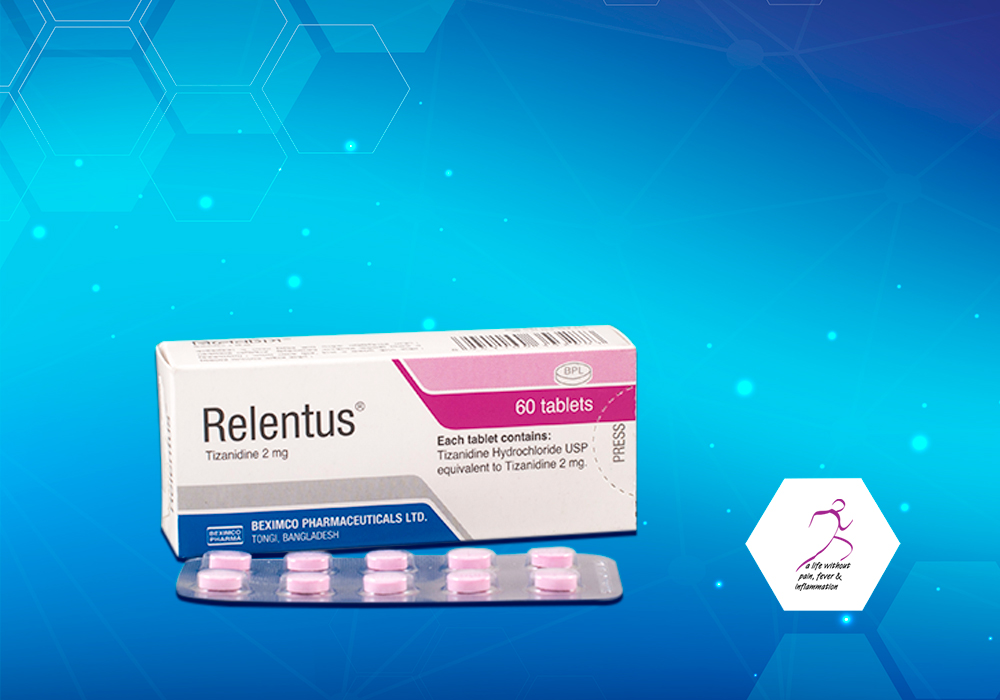
Relentus 2 Tablet
- Brand Name - Relentus Tablet
- Generic Name - Tizanidine Hydrochloride
- Doges From - Tablet
- Strength - 2 mg
- Pack Size - 60s
- Manufacture - Beximco Pharmaceuticals Ltd
Customers who bought this item also bought