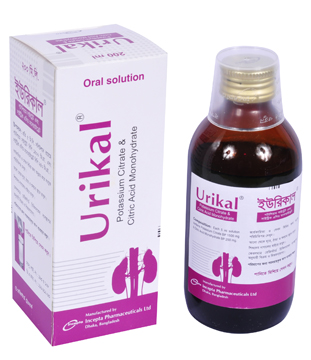
Indications - This preparation is indicated in the following cases: To relieve discomfort in urinary tract infections To prevent kidney stone With uricosuric agent to prevent gout Acidosis caused by kidney diseases
Dosage & Administration - To relieve discomfort in UTI: Adults and children over 6 years: 10 ml 3 times daily, diluted with 1 glass of water. Children 1-6 years: 5 ml 3 times daily, diluted with ½ glass of water. To prevent kidney stones, With a uricosuric agent to prevent gout, Acidosis caused by kidney diseases: Adults: 10-15 ml 4 times daily (or as directed by the physician) diluted with 1 glass of water. Pediatric: 5-10 ml 4 times daily (or as directed by the physician) diluted with ½ glass of water.
Side Effects - This solution is generally well tolerated without any unpleasant side effect when given in recommended doses to patients with normal renal function and urinary output. However, as with any alkalinizing agent, caution must be used in certain patients with abnormal renal mechanisms to avoid development of hyperkalemia or alkalosis. Potassium intoxication causes listlessness, weakness, mental confusion, tingling of extremities and other symptoms associated with a high concentration of Potassium in the serum.
Contraindications - The drug is contraindicated in severe renal impairment with oliguria or azotemia, untreated Addison's disease, acute dehydration, severe myocardial damage and hyperkalemia from any cause.
Others - Pregnancy & Lactation No information is available regarding the use of this drug during pregnancy and lactation. Precautions & Warnings The solution should be used with caution in patients with low urinary output. It should be diluted adequately with water to minimize the possibility of gastrointestinal injury associated with the oral ingestion of concentrated Potassium salt preparations; and preferably, to take each dose after meals. Large doses may cause hyperkalemia and alkalosis, especially in the presence of renal disease. Overdose Effects The administration of oral Potassium salts to persons with normal excretory mechanisms for potassium rarely causes serious hyperkalemia. However, if excretory mechanisms are impaired, hyperkalemia can result. Hyperkalemia, when detected, must be treated immediately because lethal levels can be reached in a few hours. If hyperkalemia occurs, treatment measures will include the followings: (1) Elimination of foods or medications containing potassium. (2) The intravenous administration of 300 to 500 ml/hr of dextrose solution (10 to 25%), containing 10 units of insulin/20 gm dextrose. (3) The use of exchange resins, hemodialysis or peritoneal dialysis. Storage Conditions Keep below 30°C temperature, away from light & moisture. Keep out of the reach of children
.jpeg "Picture of Potacit 100ml Oral Solution")
Potacit 100ml Oral Solution
- Brand Name - Potacit 200ml Oral Solution
- Generic Name - Potassium Citrate and Citric Acid
- Doges From - Oral Solution
- Strength - 1500 mg+250 mg
- Pack Size - 1s
- Manufacture - Healthcare Pharmaceutical Limited
Customers who bought this item also bought