
Indications - Neuroradiology: Lumber myelography, thoraco-cervical myelography Angiography: Cerebral angiography, selective coronary angiography, left ventriculography, aortography, angiocadiography, selective visceral arteriography, peripheral arteriography, digital subtraction angiography, venography, urography Other diagnostic procedures: Contrast enhancement in CT scanning, arthrography, fistulography.
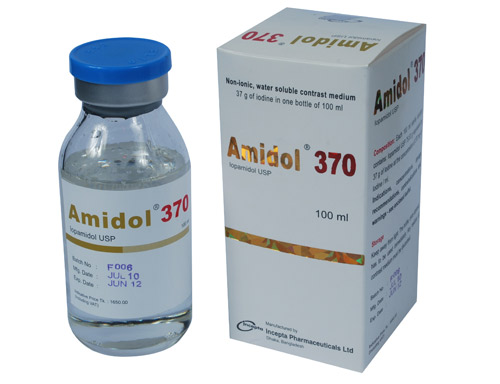
Dosage & Administration - Dosage Adult dosage: Neurology: Lumber myelography: Iopamidol 370, 6-13 ml, Thoraco-cervical myelography: Iopamidol 370, 6-13 ml. Urography: Iopamidol 370, 40-80 ml IV up to 1.5 ml/kg in severe renal disease. Children: Usual Dose: 1-2.5 ml/kg Other Diagnostic Procedure: Contrast enhancement in CT scanning: Iopamidol 370, 0.5-2.0 ml/kg Angiography: Cerebral angiography: Iopamidol 370, 6-13 ml Selective coronary arteriography: Iopamidol 370, 4-8 ml/artery Peripheral arteriography: Iopamidol 370, 20-50 ml Venography: Iopamidol 370, 24-60 ml Angiocardiography: Iopamidol 370, 30-80 ml Left ventriculography: Iopamidol 370, 30-80 ml Percutaneous transfemoral or renal arteriography: Iopamidol 370, 30 ml Selective renal arteriography: Iopamidol 370, 5-10 ml Hepatic angiography: Iopamidol 370, 70 ml Coeliac angiography: Iopamidol 370, 40-70 ml Superior mesenteric angiography: Iopamidol 370, 25-50 ml Inferior mesenteric angiography: Iopamidol 370, 5-30 ml Digital subtraction angiography: 30-50 ml (10-20 ml/sec) of Iopamidol 370, IV 25 ml (left ventricle), 2-5 ml (coronary arteries) ,15 ml/sec. of Iopamidol 370 i.a for cardiac imaging Administration NEURORADIOLOGY- Lumber myelography: A slow sub-arachnoid injection is made through a fine lumber puncture needle into one of the lower interspinous spaces (L3-L4 or L4-L5). Optimum contrast appears immediately after injections and films should be obtained promptly. Thoraco-cervical myelography: Following a slow sub-arachnoid injection the patient should be turned on his/her side and tilted 10o-20o head down under fluoroscopic control. In this manner it is possible to control movement of the contrast medium column into the dorsal region. If the cervical region is to be examined, the contrast medium should be run into the cervical region first, before the examination of the dorsal areas where it is progressively diluted. Iopamidol 300/370 may also be injected sub-occipitally or by lateral puncture technique .Care should be taken to ensure that the contrast medium does not move intracranially. It is generally recommended that in intrathecal use the patient should remain with a raised bed head and be kept well hydrated; following hydration it is preferable that the patient be allowed to be ambulatory . ANGIOGRAPHY- Cerebral angiography: Any current technique is suitable for radiological visualization of the cerebral vasculature with Iopamidol 370/300 injection. Carotid and vertebral angiography, performed by catheterization or percutaneous injection techniques, require rapid injection which, if necessary, may be repeated. Peripheral arteriography and venography: Percutaneous injection into the appropriate blood vessel is used for visualization of peripheral arteries and veins. Angiocardiography, left ventriculography, selective coronary arteriography: Iopamidol 370/300 injection may be administered by rapid injection through a catheter into a suitable peripheral artery or vein. It can also be introduced under pressure through a cardiac catheter in to any of the heart chambers, or injected into large vessel for immediate visualization. The contrast medium may also be administered during selective catheterization of the coronary arteries. Aortography: The contrast medium may be introduced directly or by intra-arterial injection for visualization of the aorta and its main branches. Selective visceral angiography: Visualization can be achieved by selective catheterization and injection into the hepatic, coeliac or mesenteric arteries. Digital subtraction angiography: For cardiac imaging the contrast medium may be administered intra-arterially by selective catheterization to provide substrated images. Iopamidol 370/300 injected intravenously either centrally or peripherally is also recommended for use this modality. UROGRAPHY- The contrast medium injected intravenously and rapidly eliminated through the kidneys. In patients with severe renal failure, high dose urography should be used. OTHER DIAGNOSTIC PROCEDURES- Arthrography: Visualization of joint cavities and articular surfaces can be achieved either single or double contrast examination. Contrast enhancement in CT scanning: Contrast enhancement for brain scans can be achieved between one and three minutes after i.v. injection. Iopamidol 370/300 are also be used for total body scanning examinations after i.v.administration as a bolus, as a drip infusion or by combination of the two methods.
Side Effects - Common side effects are arrhythmias, arterial spasm, flushing, vasodilatation, angina, cardiopulmonary arrest; dizziness, confusion, paraesthesia, visual disturbances, seizure, paralysis, coma, temporary amnesia; inj site pain, pallor, periorbital and facial oedema; coughing, sneezing, rhinitis, asthma, apnoea, laryngeal oedema, chest tightness; watery itchy eyes, lachrymation, conjunctivitis; muscle spasm, involuntary leg movement; tremors, malaise; severe retching and choking, abdominal pain; urogenital pain, haematuria.
Contraindications - There are no definite or absolute contraindications to the use of Amidol, with the possible exception of waldenstrom's macroglobulinemia, multiple myeloma and severe liver and kidney disease.
Others - Pregnancy & Lactation Iopamidol injection should be administered in pregnancy only if the procedure is considered essential by the physician. Precautions & Warnings May inhibit blood coagulation. Multiple myeloma or other paraproteinaemia. Sickle-cell disease. Known or suspected phaeochromocytoma (monitor closely). Hyperthyroidism. Ensure adequate hydration. History of a previous sensitivity to a contrast medium, sensitivity to iodine, bronchial asthma, hay fever and food allergy. Monitor patients with CHF. Avoid angiography in patients with homocystinuria. Severe arterial or venous disease. Severe renal impairment, combined renal and hepatic disease or anuria, especially when large doses are used. Pregnancy and lactation. Overdose Effects Treatments of an overdose is directed toward the support of all vital functions and prompt institution of symptomatic therapy.
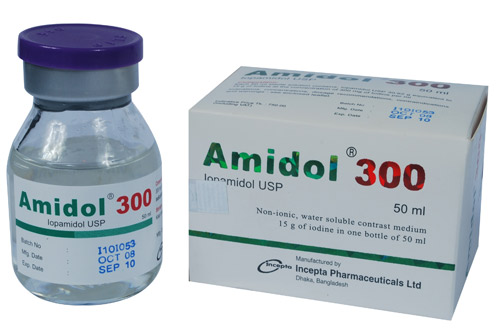
Amidol 300 Injection
- Brand Name - Amidol 300 Injection
- Generic Name - Iopamidol
- Doges From - Injection
- Strength - 300 mg
- Pack Size - 50 ml
- Manufacture - Incepta Pharmaceuticals Ltd.
Customers who bought this item also bought