Indications - Therapy with lipid-altering agents should be only one component of multiple risk factor intervention in individuals at significantly increased risk for atherosclerotic vascular disease due to hyperlipidemia. Niacin therapy is indicated as an adjunct to diet when the response to a diet restricted in saturated fat and cholesterol and other nonpharmacologic measures alone has been inadequate. Niacin is indicated to reduce elevated TC, LDL-C, Apo B and TG levels, and to increase HDL-C in patients with primary hyperlipidemia and mixed dyslipidemia. In patients with a history of myocardial infarction and hyperlipidemia, niacin is indicated to reduce the risk of recurrent nonfatal myocardial infarction. In patients with a history of coronary artery disease (CAD) and hyperlipidemia, niacin, in combination with a bile acid binding resin, is indicated to slow progression or promote regression of atherosclerotic disease. Niacin in combination with a bile acid binding resin is indicated to reduce elevated TC and LDL-C levels in adult patients with primary hyperlipidemia. Niacin is also indicated as adjunctive therapy for treatment of adult patients with severe hypertriglyceridemia who present a risk of pancreatitis and who do not respond adequately to a determined dietary effort to control them.
Dosage & Administration - Dosage Niacin can be administered as a single dose at bedtime, after a snack or meal and doses should be individualized according to patient response. Therapy with Niacin must be initiated at 500 mg in order to reduce the incidence and severity of side effects which may occur during early therapy. Maintenance Dose: The daily dosage of Niacin should not be increased by more than 500 mg in any 4-week period. The recommended maintenance dose is 1000 mg (two 500 mg tablets or one 1000 mg tablet) to 2000 mg (two 1000 mg tablets or four 500 mg tablets) once daily at bedtime. Doses greater than 2000 mg daily are not recommended. Women may respond at lower Niacin doses than men. Single-dose bioavailability studies have demonstrated that two of the 500 mg and one of the 1000 mg tablet strengths are interchangeable but three of the 500 mg and two of the 750 mg tablet strengths are not interchangeable. Flushing of the skin may be reduced in frequency or severity by pretreatment with aspirin (up to the recommended dose of 325 mg taken 30 minutes prior to Niacin dose). Tolerance to this flushing develops rapidly over the course of several weeks. Flushing, pruritus, and gastrointestinaldistress are also greatly reduced by slowly increasing the dose of niacin and avoiding administration on an empty stomach. Concomitant alcoholic, hot drinks or spicy foods may increase the side effects of flushing and pruritus and should be avoided around the time of Niacin ingestion. Equivalent doses of Niacin should not be substituted for sustained-release (modified-release, timed-release) niacin preparations or immediate-release (crystalline) niacin. Patients previously receiving other niacin products should be started with the recommended Niacin titration schedule, and the dose should subsequently be individualized based on patient response. If Niacin therapy is discontinued for an extended period, reinstitution of therapy should include a titration phase. Administration Niacin tablets should be taken whole and should not be broken, crushed or chewed before swallowing.
Side Effects - Side Effects Niacin is generally well tolerated; adverse reactions have been mild and transient.The most frequent advers effects were flushing, itching, pruritis, nausea and GI upset, jaundice ,hypotension, tachycardia, increased serum blood glucose and uric acid levels, myalgia.
Contraindications - Contraindications Niacin is contraindicated in patients with a known hypersensitivity to Niacin or any component of this medication, significant or unexplained hepatic dysfunction, active peptic ulcer disease or arterial bleeding
Others - Pregnancy & Lactation Niacin cannot be used in pregnancy and lactation because of a lack of information.
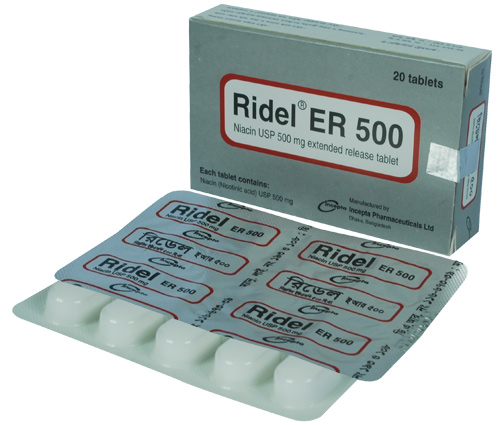
Ridel ER Tablet
- Brand Name - Ridel ER 500 Tablet
- Generic Name - Niacin
- Doges From - Tablet
- Strength - 500 mg
- Pack Size - 20s
- Manufacture - Incepta Pharmaceuticals Ltd.
Customers who bought this item also bought