

Indications - Induction and maintenance of general anaesthesia. Sedation during intensive care. Sedation for surgical and diagnostic procedures.
Dosage & Administration - Dosage Adults: Induction of general anaesthesia: The dosage of Propofol should be titrated individually against the response of the patient. The ordinary initial dosage in adults is 40 mg (4 ml) by slow intravenous bolus injection at intervals of 10 seconds until the clinical signs show the onset of anaesthesia. The ordinary induction dose in healthy patient below 55 years of age is 2.2-2.5 mg/kg. A dose of 1.0-1.5 mg/kg is often sufficient for older patient. Lower doses, most often 20 mg (2 ml) at intervals of 10 seconds, are recommended for patient of ASA grades 3 and 4. Maintenance of general anaesthesia: Anaesthesia can be maintained by administering Propofol either by continuous infusion or by repeat bolus injections to maintain sufficient anaesthesia. Continuous infusion: The required rate of infusion varies considerably between patients. At the onset of anaesthesia (during roughly the first 10-20 minutes), some patient may require a slightly higher infusion rate (8-10 mg/kg/h). However, sufficient anaesthesia is normally achieved by infusing 4-6 (up to 12) mg/kg/h of Propofol. Repeat bolus injections: 25-50 mg (2.5-5.0 ml) bolus injections, depending on response. Sedation during intensive care: A bolus injection of 1.0-2.0 mg/kg should be given first, followed by continuous infusion adjusted according to required degree of sedation. An infusion rate of 0.3-4 mg/kg/h is usually sufficient. Sedation for surgical and diagnostic procedures: Dosages shall be adjusted individually. Sufficient sedation for surgical and diagnostic procedures can usually be achieved by administering initially 0.5-1 mg/kg during 1-5 minutes, and maintained by continuous at a rate of 1-4.5 mg/kg/h. Bolus dose of 10-20 mg can be given in addition, should deeper sedation be suddenly required. Lower doses of Propofol are often sufficient for patient of ASA grades 3 and 4, and for older patient. Children: Propofol is not recommended for use in children less then 3 years of age as its safety has not been demonstrated. Induction of general anaesthesia: Dosage of Propofol in children shell be adjusted for weight and age. The mean induction dosage in children over 8 years is 2.5 mg/kg, given by slow intravenous injection until the clinical signs show the onset of anaesthesia. Younger children may need slightly higher doses of propofol per kilogram of weight. Lower dosages are recommended for children of ASA grades 3 and 4. Maintenance of general anaesthesia: Anaesthesia can be maintained by administering Propofol either by continuous infusion or by repeat bolus injections. Dosage shall be adjusted individually, but an infusion rate of 9-15 mg/kg/h is usually sufficient to achieve satisfactory anaesthesia. Sedation during intensive care, surgical diagnostic procedures: Propofol is not recommended for sedation in children as its efficacy and safety have not been demonstrated. Although no casual relationship has been established, serious adverse events (including fatalities) have been reported in cases, where propofol has been used against recommendations. Adverse events have most commonly been seen in children with respiratory tract infections given doses in excess of those recommended for adults. Administration Method of administration: In order to reduce pain on injection, the induction dose of propofol may be mixed immediately before injection in the palstic syringe with lidocaine 10 mg/ml injection, in a ratio of 1 part of lidocaine injection for 20 parts of Propofol. Propofol can be administered either undiluted or diluted for infusion. Before injection or dilution, each ampoule or vial shall be ispected for any irregularity. Should any changes be observed, the product shall not be used. Suitable equipment shall be used to ensure correct rate of infusion. Volumetric infusion pumps and syringe pumps, for example, are suitable for this purpose. The ordinary infusion set used alone is not sufficient to prevent accidential overdosage reliably enough. Compatibility: Propofol may be diluted only with 5% dextrose infusion. Dilution shall not exceed 1 in 5 (containing 2 mg/ml Propofol) and shall be prepared in a PVC infusion bag or glass infusion bottle. If a PVC infusion bag is used, the bag should be full and the dilution be prepared by withdrawing a volume of infusion fluid and replacing it with an equal volume of Propofol. Special attention shall be paid to preparing the dilution aseptically, immediately before administration. Any diluted solution shall be used within 6 hours of preparation. Any remaining solution shall be discarded.
Side Effects - Side Effects Local: Propofol is normally well tolerated. Its most common undesirable effect is pain at the site of injection that can be reduced by mixing the preparation with lidocaine or by injecting it into one of the larger veins of the forearm or the intercubital fossa. Thrombosis and phlebitis are rare. General: Hypotension and transient apnea may occur at the induction of anaesthesia, and may be severe especially in patients who are in a poor general condition. Epileptic movement, convulsions and dystonic reactions have been seen in rare cases. Pulmonary oedema has also been reported. Headache, nausea and, more rarely, vomiting may occur in some patients during recovery. Recovery may also be associated with another short period of impaired consciousness. Hypersensitivity has been reported in some cases, connected with anaphylactic symptoms such as marked hypotension, bronchospasm, oedema and facial erythema. Some cases of cardiac arrest have occurred in connection with the administration of propofol. In connection with long-term administration of propofol, green or reddish brown discolouration of urine may occur. This is caused by the quinol metabolites of propofol, and is not dangerous. As with other anaesthetics, altered sexual behaviour may occur.
Contraindications - Allergy to propofol or any other ingredient in the preparation.
Others - Pregnancy & Lactation Due to insufficient experience, propofol shall not be used during pregnancy. Propofol is rapidly distributed to the foetus and shall therefore not be used for obstetric anaesthesia. Safety to the neonate has not been established in cases, where propofol has been administered to lactating women.
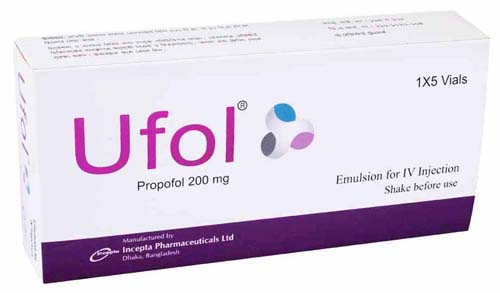
Ufol 200 IV Injection
- Brand Name - Ufol Emulsion for infusion
- Generic Name - Propofol
- Doges From - Injection
- Strength - 200 mg
- Pack Size - 20 ml
- Manufacture - Incepta Pharmaceuticals Ltd.
Customers who bought this item also bought
