

Indications - Spironolactone is indicated in Congestive heart failure, Hepatic cirrhosis with ascites and oedema, Nephrotic syndrome, Primary hyperaldosteronism, Essential hypertension, For the treatment of patients with hypokalemia
Dosage & Administration - Edema in adults (congestive heart failure, hepatic cirrhosis, or nephrotic syndrome): An initial daily dosage of 100 mg of Spironolactone administered in either single or divided doses is recommended, but may range from 25 to 200 mg daily. Combined therapy with other diuretics is indicated when more rapid diuresis is desired. Primary hyperaldosteronism: After the diagnosis of hyperaldosteronism has been established, Spironolactone may be administered in doses of 100 to 400 mg daily in preparation for surgery. For patients who are considered unsuitable for surgery, Spironolactone may be employed for long-term maintenance therapy at the lowest effective dosage determined for the individual patient. Essential hypertension: For adults, an initial daily dosage of 50 to 100 mg of Spironolactone administered in either single or divided doses is recommended. Hypokalemia: Spironolactone in a dosage ranging from 25 mg to 100 mg daily is useful in treating a diuretic-induced hypokalemia.
Side Effects - Gynaecomastia may develop in association with the use of Spironolactone. Other adverse reactions are: GI symptoms including cramping and diarrhoea, drowsiness, lethargy, headache, urticaria, mental confusion, impotence, irregular menses or amenorrhoea and post-menopausal bleeding.
Contraindications - Spironolactone is contraindicated in patients with acute renal insufficiency, significant impairment of renal function, anuria, hyperkalaemia or sensitivity to Spironolactone.
Others - Pregnancy & Lactation Pregnancy: Spironolactone should not be used during pregnancy Lactation: Canrenone, an active metabolite of Spironolactone, appears in breast milk. If use of the drug is deemed essential an alternative method of infant feeding should be instituted.
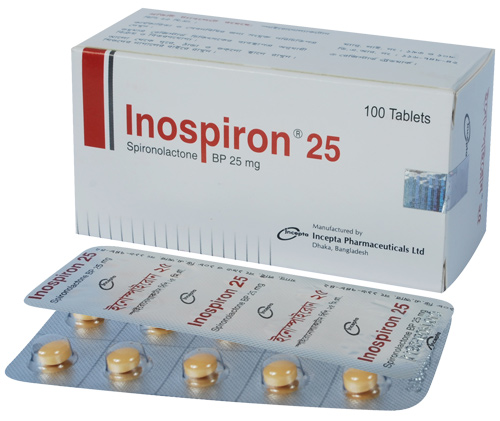
Inospiron 25 Tablet
- Brand Name - Inospiron 25 Tablet
- Generic Name - Spironolactone
- Doges From - Tablet
- Strength - 25 mg
- Pack Size - 100s
- Manufacture - Incepta Pharmaceuticals Ltd.
Customers who bought this item also bought
