
Indications - Bivalirudin is indicated for: Anticoagulant in Patients Undergoing PTCA/PCI or PCI with HITS/HITTS Unstable Angina/Non-ST-Elevation MI (Off-label) STEMI Undergoing Primary PCI (Off-label) Heparin-induced Thrombocytopenia
Dosage & Administration - Dosage : PCI/PTCA: IV Bolus dose of 0.75 mg/kg followed by an infusion of 1.75 mg/kg/h for duration of PCI procedure. Five minutes after bolus dose, obtain ACT and administer additional bolus of 0.3 mg/kg if indicated. HIT/HITTS: IV Bolus dose of 0.75 mg/kg, followed by a continuous infusion at a rate of 1.75 mg/kg/h for the duration of the procedure. Continuation of Therapy: IV Infusion may be continued for up to 4 h post-procedure as indicated. After 4 h, an additional IV infusion of 0.2 mg/kg/h for up to 20 h may be given if needed. Concomitant Therapy: Bivalirudin is intended for concurrent use with aspirin (300 to 325 mg/day). Administration : For IV administration only. Not for intradermal, subcutaneous, IM, or intra-arterial administration. Reconstitute powder for injection with 5 mL sterile water for injection. Gently swirl until powder is dissolved. For initial bolus infusion, further dilute each reconstituted via in 50 mL of 5% dextrose in water or sodium chloride 0.9% for injection to yield a final concentration of 5 mg/mL. For low rate infusion, further dilute each reconstituted vial in 500 mL of 5% dextrose in water or sodium chloride 0.9% for injection to yield a final concentration of 0.5 mg/mL. Do not mix with the following drugs in the same IV line: alteplase, amiodarone, amphotericin B, chlorpromazine, diazepam, dobutamine, prochlorperazine, reteplase, streptokinase, vancomycin. Reconstituted bivalirudin should be a clear to slightly opalescent, colorless to slightly yellow solution. Do not administer if reconstituted or diluted solution is discolored, cloudy, or contains particulate matter. Maintain meticulous catheter technique, with frequent aspiration and flushing, paying special attention to minimizing conditions of stasis within the catheter or vessels. Discard any unused reconstituted or diluted solution.
Side Effects - Bleeding, Body as a Whole: fever,infection, sepsis; Cardiovascular: hypotension, syncope, vascular anomaly,ventricular fibrillation; Nervous: cerebral ischemia, confusion, facialparalysis; Respiratory: lung edema; Urogenital: kidney failure, oliguria.
Contraindications - Bivalirudin is contraindicated in patients with: Active major bleeding & Hypersensitivity (e.g., anaphylaxis) to Bivalirudin or its components
Others - Pregnancy & Lactation : Pregnancy Category B. No adequate and well-controlled studies in pregnant women. As animal reproduction studies are not always predictive of human response, this drug should be used during pregnancy only if clearly needed. Bivalirudin is intended for use with aspirin . Because of possible adverse effects on the neonate and the potential for increased maternal bleeding, particularly during the third trimester, Bivalirudin and aspirin should be used together during pregnancy only if clearly needed. Nursing Mothers: It is not known whether bivalirudin is excreted in human milk. As many drugs are excreted in human milk, caution should be exercised when Bivalirudin is administered to a nursing woman.
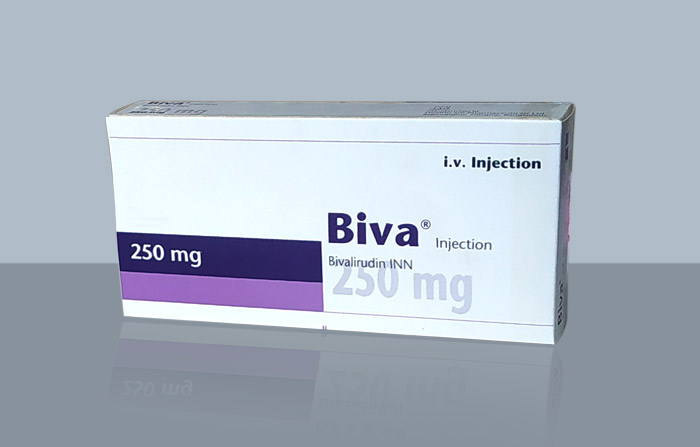
Biva 250 IV Injection
- Brand Name - Biva 250 IV Injection
- Generic Name - Bivalirudin
- Doges From - Injection
- Strength - 250 mg
- Pack Size - 5 ml
- Manufacture - Healthcare Pharmaceutical Limited
Customers who bought this item also bought