

Indications - Paroxetine is indicated in: Major Depressive Disorder Obsessive Compulsive Disorder Panic Disorder Social Anxiety Disorder Generalized Anxiety Disorder Posttraumatic Stress Disorder.
Dosage & Administration - Major Depressive Disorder: Usual Initial Dosage: Paroxetine (Paroxetine hydrochloride) should be administered as a single daily dose with or without food, usually in the morning. The recommended initial dose is 20 mg/day. Some patients not responding to a 20 mg dose may benefit from dose increases, in 10 mg/day increments, up to a maximum of 50 mg/day. Dose changes should occur at intervals of at least 1 week. Maintenance Therapy: Systematic evaluation of the efficacy of Paroxetine hydrochloride has shown that efficacy is maintained for periods of up to 1 year with doses that averaged about 30 mg. Obsessive Compulsive Disorder (OCD): Usual Initial Dosage: Paroxetine (Paroxetine hydrochloride) should be administered as a single daily dose with or without food, usually in the morning. The recommended dose of Paroxetine in the treatment of OCD is 40 mg daily. Patients should be started on 20 mg/day and the dose can be increased in 10 mg/day increments. Dose changes should occur at intervals of at least 1 week. Maintenance Therapy: Dosage adjustments should be made to maintain the patient on the lowest effective dosage, and patients should be periodically reassessed to determine the need for continued treatment. Panic Disorder: Usual Initial Dosage: Paroxetine should be administered as a single daily dose with or without food, usually in the morning. The target dose of Paroxetine in the treatment of panic disorder is 40 mg/day. Patients should be started on 10 mg/day. Dose changes should occur in 10 mg/day increments and at intervals of at least 1 week. The maximum dosage should not exceed 60 mg/day. Maintenance Therapy: Dosage adjustments should be made to maintain the patient on the lowest effective dosage, and patients should be periodically reassessed to determine the need for continued treatment. Social Anxiety Disorder (SAD): Usual Initial Dosage: Paroxetine should be administered as a single daily dose with or without food, usually in the morning. The recommended initial dosage is 20 mg/day. Maintenance Therapy: Dosage adjustments should be made to maintain the patient on the lowest effective dosage, and patients should be periodically reassessed to determine the need for continued treatment. Generalized Anxiety Disorder (GAD): Usual Initial Dosage: Paroxetine should be administered as a single daily dose with or without food, usually in the morning. The recommended starting dosage and the established effective dosage is 20 mg/day. Maintenance Therapy: Dosage adjustments should be made to maintain the patient on the lowest effective dosage, and patients should be periodically reassessed to determine the need for continued treatment. Posttraumatic Stress Disorder (PTSD): Usual Initial Dosage: Paroxetine should be administered as a single daily dose with or without food, usually in the morning. The recommended starting dosage and the established effective dosage is 20 mg/day. Dose changes, if indicated, should occur in 10 mg/day increments and at intervals of at least 1 week. Maintenance Therapy: Dosage adjustments should be made to maintain the patient on the lowest effective dosage, and patients should be periodically reassessed to determine the need for continued treatment.
Side Effects - Major depressive disorder: Asthenia, sweating, nausea, decreased appetite, somnolence, dizziness, insomnia, tremor, nervousness, ejaculatory disturbance and other male genital disorders. Obsessive compulsive disorder: Nausea, dry mouth, decreased appetite, constipation, dizziness, somnolence, tremor, sweating, impotence and abnormal ejaculation. Panic disorder: Asthenia, sweating, decreased appetite, decreased libido , tremor, abnormal ejaculation, female genital disorders and impotence. Social anxiety disorder: Sweating, nausea, dry mouth, constipation, decreased appetite, somnolence, tremor, decreased libido, yawn, abnormal ejaculation, female genital disorders and impotence. Generalised anxiety disorder: Asthenia, infection, constipation, decreased appetite, dry mouth, nausea, decreased libido, somnolence, tremor, sweating and abnormal ejaculation. Post-traumatic stress disorder: Asthenia, sweating nausea, dry mouth, diarrhoea, decreased appetite, somnolence, decreased libido, abnormal ejaculation, female genital disorders and impotence.
Contraindications - Concomitant use in patients taking either monoamine oxidase inhibitors (MAOIs) or thioridazine is contraindicated. This is contraindicated in patients with a hypersensitivity to Paroxetine.
Others - Pregnancy & Lactation This drug should be used during pregnancy only if the potential benefit justifies the potential risk to the fetus. Labor and Delivery: The effect of Paroxetine on labor and delivery in humans is unknown. Nursing Mothers: Like many other drugs, Paroxetine is secreted in human milk, and caution should be exercised when Paroxetine hydrochloride is administered to a nursing woman.
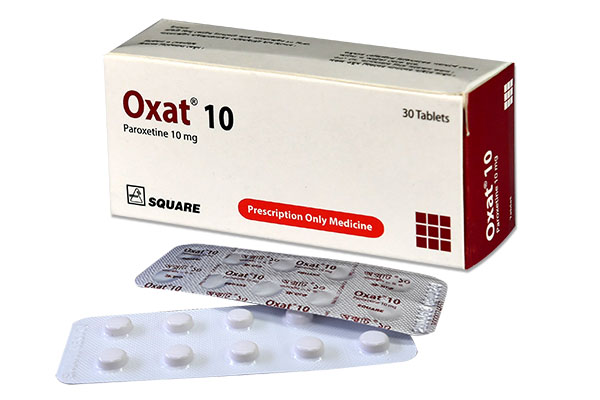
Tablet Oxat 10 mg
- Brand Name - Oxat 10
- Generic Name - Paroxetine Hydrochloride
- Doges From - Tablet
- Strength - 10 mg
- Pack Size - 30s
- Manufacture - Square Pharmaceutical Ltd.


