Indications - Valganciclovir is indicated for the treatment of cytomegalovirus (CMV) retinitis in adult patients with acquired immunodeficiency syndrome (AIDS). Valganciclovir is indicated for the prevention of CMV disease in adult and pediatric solid organ transplant (SOT) patients who are at risk.
Dosage & Administration - Standard Dosage: Valganciclovir is administered orally, and should be taken with food. Valganciclovir is rapidly and extensively converted into the active ingredient ganciclovir. The bioavailability of ganciclovir from Valganciclovir is up to 10-fold higher than from oral ganciclovir. The dosage and administration of Valganciclovir tablets or powder for oral solution as described below should be closely followed. The ganciclovir systemic exposure following administration of 900 mg Valganciclovir powder for oral solution is equivalent to a 900 mg Valganciclovir dose administered as two 450 mg tablets. An oral dosing dispenser with 25 mg graduations up to 500 mg is provided with the powder for oral solution. It is recommended that this dispenser is used to measure and administer the dose. Treatment of cytomegalovirus (CMV) retinitis- Adult patients: Induction treatment of CMV retinitis: For patients with active CMV retinitis, the recommended dose is 900 mg twice a day for 21 days. Prolonged induction treatment may increase the risk of bone marrow toxicity Maintenance treatment of CMV retinitis: Following induction treatment, or in adult patients with inactive CMV retinitis, the recommended dose is 900 mg once daily. Patients whose retinitis worsens may repeat induction treatment. The duration of maintenance treatment should be determined on an individual basis. Pediatric patients: The safety and efficacy of Valganciclovir in the treatment of CMV retinitis have not been established in adequate and well-controlled clinical studies in pediatric patients. Prevention of CMV disease in transplantation- Adult patients: For kidney transplant patients, the recommended dose is 900 mg once daily starting within 10 days post-transplantation and continuing until 200 days post-transplantation. For patients who have received a solid organ transplant other than kidney, the recommended dose is 900 mg once daily starting within 10 days post-transplantation and continuing until 100 days post-transplantation. Pediatric patients: In pediatric solid organ transplant patients from birth, who are at risk of developing CMV disease, the recommended once daily dose of Valganciclovir is based on body surface area (BSA) and creatinine clearance (ClCr) derived from Schwartz formula (ClCr), and is calculated using the equation below: Pediatric dose (mg)= 7 x BSA x ClCr. If the creatinine clearance exceeds 150 ml/min/1.73 m2, then a maximum value of 150 ml/min/1.73 m2
Side Effects - The following serious adverse reactions are discussed in greater detail in other sections of the labeling: Hematologic Toxicity Acute Renal Failure Impairment of Fertility Fetal Toxicity Mutagenesis and Carcinogenesis
Contraindications - Valganciclovir is contraindicated in patients with known hypersensitivity to valganciclovir, ganciclovir or to any of the excipients.
Others - Pregnancy & Lactation Pregnancy: The safety of Valganciclovir for use in pregnant women has not been established. However, ganciclovir readily diffuses across the human placenta. The use of Valganciclovir should be avoided in pregnant women unless the benefit to the mother outweighs the potential risk to the fetus. Reprotoxicity studies have not been repeated with valganciclovir because of the rapid and extensive conversion to ganciclovir. In animal studies ganciclovir was associated with reproductive toxicity and teratogenicity (see section 3.3.4 Reproductive Toxicity). The safe use of Valganciclovir during labor and delivery has not been established. Lactation: Peri- and postnatal development has not been studied with valganciclovir or with ganciclovir but the possibility of ganciclovir being excreted in breast milk and causing serious adverse reactions in the nursing infant cannot be discounted. Human data are not available but animal data indicates that ganciclovir is excreted in the milk of lactating rats. Therefore, a decision should be made to discontinue the drug or discontinue nursing taking into consideration the potential benefit of Valganciclovir to the nursing mother.
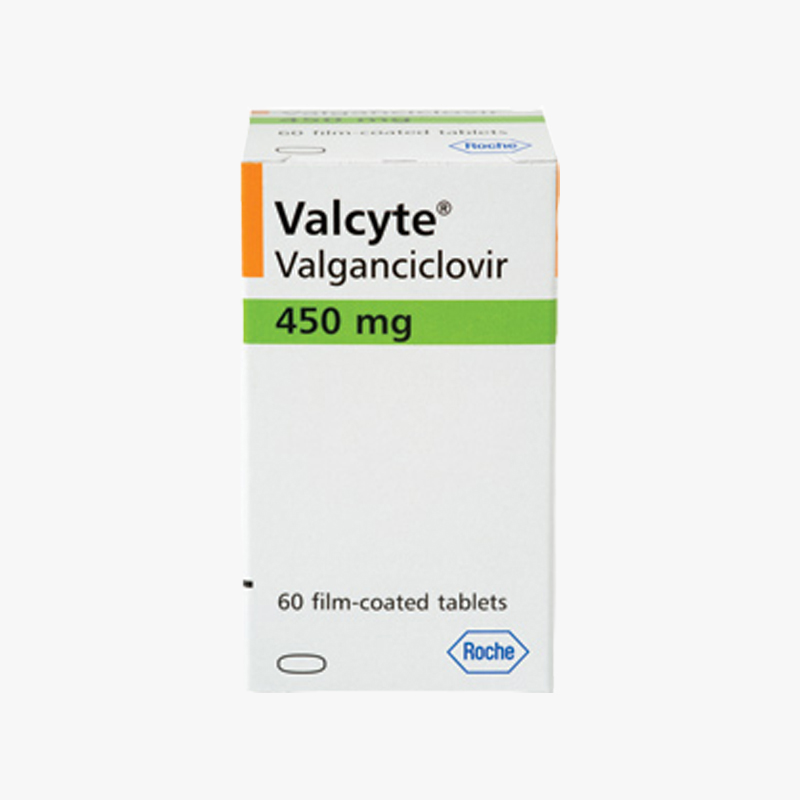
Valcyte 450mg Tablet
- Brand Name - Valcyte 450mg Tablet
- Generic Name - Valganciclovir
- Doges From - Tablet
- Strength - 450 mg
- Pack Size - 60s
- Manufacture - Roche Bangladesh Ltd.
Customers who bought this item also bought