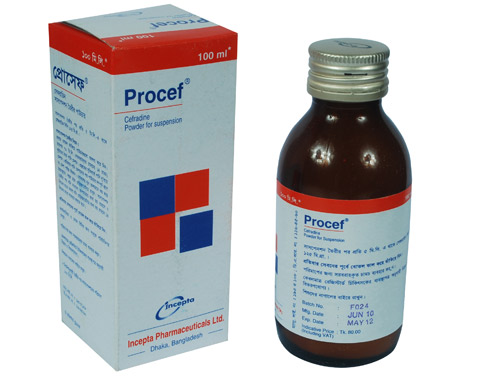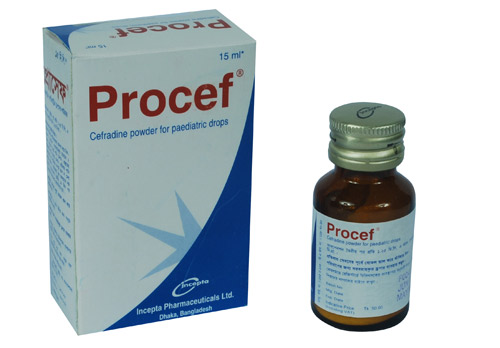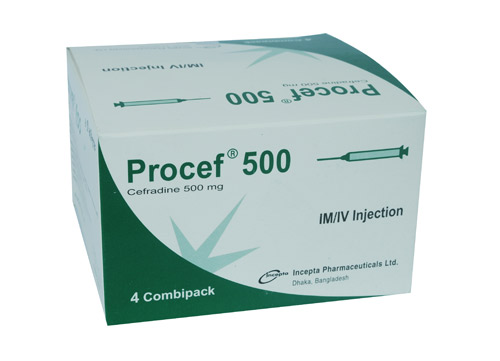

Indications - Cephradine is indicated for the treatment of infections caused by sensitive Gram-positive and Gram-negative bacteria. These include- Undesirable Upper respiratory tract infections: sinusitis, pharyngitis, tonsillitis, laryngo-tracheo bronchitis and otitis media, and also Lower respiratory tract infections: bronchitis (acute and chronic), lobar pneumonia and bronchopneumonia. Urinary tract infections: cystitis, urethritis and pyelonephritis. Skin and soft tissue infections: abscess, cellulitis, furunculosis and impetigo. The following microorganisms are susceptible, in vitro to Cephradine: Gram-positive: Staphylococci (both penicillin sensitive and resistant strains and penicillinase-producing species), Streptococci, Streptococci pyogenes (beta haemolytic), Streptococcus pneumonia. Gram-negative: Escherichia coli, Klebsiella spp, Proteus mirabilis, Haemophilus influenza, Shigella spp, Salmonella spp (including Salmonella typhi), Neisseria spp Many strains of E.coli and Staphylococcus aureus that produce the enzyme penicillinase and thus are ampicillin resistant, are susceptible to Cephradine which is unaffected by this enzyme.
Dosage & Administration - For oral administration- Adults: Urinary tract infections: 500mg four times daily or 1g twice daily. Infections which are severe or chronic may necessitate the administration of higher doses. Where complications arise including prostatitis and epididymitis continued intensive treatment is required. Respiratory tract infections: 250 to 500mg four times daily or 500mg to 1g twice daily, dependent on the site and severity of the infection. Skin and soft tissue infections: 250 to 500mg four times daily or 500mg to 1g twice daily, again dependent on the site and severity of the infection. Children: Total daily dose of 25 to 50mg/kg given in two or four equally divided doses. Otitis media: Total daily dose of 75 to 100mg/kg given in divided doses 6 to 12 hourly. Maximum daily dosage: 4 gm Elderly: The normal adult dose is appropriate. Patients with impaired renal or hepatic function should be monitored during treatment. For injectable administration- Adult: The usual dose is 2-4 gm daily in four equally divided doses up to 8 gm daily. For prophylaxis a single preoperative dose of 1-2 gm intramuscularly or intravenously is given. Children: The dose is 50-100 mg/kg daily in four equally divided doses, up to 300 mg/kg daily in severe infection.
Side Effects - Limited essentially to gastro-intestinal disturbances and on occasions to hypersensitivity phenomena. The latter are more likely to occur in individuals, who have previously demonstrated hypersensitivity and thos with a history of allergy, asthma, hay fever or urticaria. Skin reactions have occasionally been reported. Rare- Glossitis, heartburn, dizziness, tightness in the chest, nausea, vomiting, diarrhoea, abdominal pain, vaginitis, candida overgrowth. Skin and hypersensitivity reactions include urticaria, skin rashes, joint pains, oedema. Blood and lymphatic system disorders- Unknown: blood disorders (including thrombocytopenia, leucopenia, agranulocytosis, aplastic anaemia and haemolytic anaemia) Immune system disorders- Unknown: Fever, serum sickness like reactions, anaphylaxis Psychiatric disorders- Unknown: Confusion, sleep disturbances Nervous system disorders- Unknown: hyperactivity, hypertonia, dizziness, nervousness; Rarely: Headache Hepatobiliary disorders- Frequency unknown: Liver, enzyme disturbances, transient hepatitis, cholestatic jaundice Renal and urinary disorders- Unknown: Reversible interstitial nephritis Investigations- Unknown: Elevation of blood urea nitrogen, serum creatinine, alanine aminotransferase, aspartate aminotransferase, total bilirubin, alkaline phosphatase.
Contraindications - Limited essentially to gastro-intestinal disturbances and on occasions to hypersensitivity phenomena. The latter are more likely to occur in individuals, who have previously demonstrated hypersensitivity and thos with a history of allergy, asthma, hay fever or urticaria. Skin reactions have occasionally been reported. Rare- Glossitis, heartburn, dizziness, tightness in the chest, nausea, vomiting, diarrhoea, abdominal pain, vaginitis, candida overgrowth. Skin and hypersensitivity reactions include urticaria, skin rashes, joint pains, oedema. Blood and lymphatic system disorders- Unknown: blood disorders (including thrombocytopenia, leucopenia, agranulocytosis, aplastic anaemia and haemolytic anaemia) Immune system disorders- Unknown: Fever, serum sickness like reactions, anaphylaxis Psychiatric disorders- Unknown: Confusion, sleep disturbances Nervous system disorders- Unknown: hyperactivity, hypertonia, dizziness, nervousness; Rarely: Headache Hepatobiliary disorders- Frequency unknown: Liver, enzyme disturbances, transient hepatitis, cholestatic jaundice Renal and urinary disorders- Unknown: Reversible interstitial nephritis Investigations- Unknown: Elevation of blood urea nitrogen, serum creatinine, alanine aminotransferase, aspartate aminotransferase, total bilirubin, alkaline phosphatase.
Others - Pregnancy & Lactation Although animal studies have not demonstrated any teratogenicity, safety in pregnancy has not been established. Cephradine is excreted in breast milk and should be used with caution in lactating mothers. Since the medicine may cause dizziness, patients should be cautioned about operating hazardous machinery, including automobiles. Precautions & Warnings Prolonged use of an anti-infective may result in the development of superinfection due to the emergence of resistant organisms. Cephradine should be administered with care to patients hypersensitive to penicillins because of the risk of cross-sensitivity between beta-lactam antibiotics. Cephalosporin antibiotics may cause a positive result in Coombs’ testing. When Coombs testing is performed on neonates whose mothers received cephalosporins prior to labour, it should be noted that a positive result may be due to the drug. Cephradine may cause a false positive urine glucose result when Benedict’s or Fehling’s solutions or tablets such as Clinitest are used in the testing. This does not occur with enzyme-based tests (e.g. Clinistix, Diastix). Dosage adjustment is necessary in renal impairment. This product contains lactose. Patients with rare hereditary problems of galactose intolerance, the Lapp lactase deficiency or glucose-galactose malabsorption should not take this medicine. Use in Special Populations Renal Impairment: The following doses are recommended (based on 500 mg every 6 hours) for patients not on haemodialysis: CrCl: >20 ml/min: 500 mg every 6 hours CrCl: 5-20 ml/min: 250 mg every 6 hours CrCl: <5 ml/min: 250 mg every 50-70 hours. Recommendations for patients on chronic, intermittent haemodialysis: 250 mg at the start of haemodialysis 250 mg 6 to 12 hours after the start 250 mg 36 to 48 hours after the start 250 mg at the start of the next haemodialysis session if more than 30 hours have elapsed since the last dose. Additional Information for all patients Regardless of patient age or weight, higher doses of up to 1 gm four times daily may be required for infections which are chronic or severe. Treatment should continue for at least 2 to 3 days after symptoms have resolved or bacteria have been eradicated. To reduce the possibility of rheumatic fever or glomerulonephritis resulting from infections with haemolytic streptococci, treatment should be continued for at least 10 days. Throughout treatment of chronic urinary tract infections and for several months thereafter, regular bacteriological and clinical monitoring is required. Doses below those recommended above should not be prescribed. Paediatric dosages should not exceed those specified for adults, regardless of severity of infection. It may be necessary to continue Cephradine therapy for several weeks in persistent infections. Patients may be transferred from intramuscular/intravenous Cephradine therapy to oral treatment at the same dosage level. Overdose Effects The symptoms of Sefrad overdose are non-specific and are generally nausea, vomiting, diarrhoea and gastric upsets. Treatment is mainly supportive although gastric lavage will be necessary if a large amount has been ingested. Storage Conditions Cephradine Suspension should be freshly prepared. Reconstituted Suspension should be used within 7 days if kept at room temperature or within 14 days, if kept in a refrigerator. Cephradine Injection solutions should be used within 2 hours when kept at room temperature. When stored at 5°C, solutions retain potency for 12 hours. Reconstituted solutions may vary in colour from light to straw yellow; however, this does not affect the potency. Do not use later than the date of expiry. Keep all medicines out of the reach of children. To be dispensed only on the prescription of a registered physician
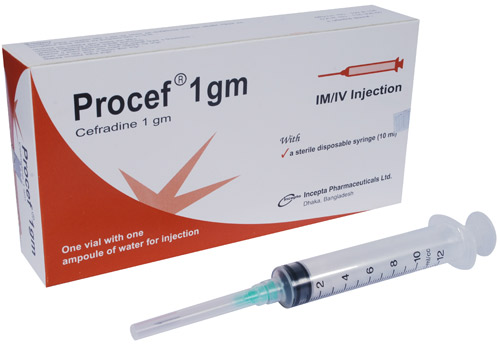
Procef 1gm IM/IV Injection
- Brand Name - Procef 1gm IM/IV Injection
- Generic Name - Cefradine
- Doges From - Injection
- Strength - 1 gm
- Pack Size - 1s
- Manufacture - Incepta Pharmaceuticals Ltd.
Customers who bought this item also bought