

Indications - Hypertension (Primary and Secondary Hypertension). Raynaud's phenomenon and Raynaud's disease, Congestive heart failure (Prazosin may be used alone or added to the therapeutic regimen in those patients with congestive heart failure who are resistant or refractory to conventional therapy with diuretics and/or cardiac glycosides) & Benign prostatic hyperplasia (For the symptomatic treatment of urinary obstruction due to BPH and in patients awaiting prostatic surgery).
Dosage & Administration - Dosage Hypertension: Recommended starting dose: 0.5 mg (in the evening), twice or thrice daily for 3 to 7 days. This dose should be increased to 1 mg twice or three times daily for a further 3 to 7 days. Thereafter, the daily dose should be increased gradually as determined by the patient's response to the blood pressure lowering effect. Most patients are likely to be maintained on a dosage regimen of Prazosin alone of up to 15 mg daily in divided doses. Maximum dose: 20 mg in divided doses. Patients receiving other antihypertensive therapy but with inadequate control: The dosage of the other drug should be reduced to a maintenance level and Prazosin initiated at 0.5 mg in the evening, then continuing with 0.5 mg twice or three times daily. Subsequent dosage increases should be made gradually depending upon the patient's response. Congestive heart failure: The recommended starting dose: 0.5 mg two, three or four times daily, increasing to 4 mg in divided doses. Dosage should be adjusted according to the patient's response, based on careful monitoring of cardiopulmonary signs and symptoms. Usual daily maintenance dosage: 4 mg to 20 mg in divided doses. Raynaud's disease: The recommended starting dosage: 0.5 mg twice daily given for a period of 3 to 7 days and should be adjusted according to the patient's clinical response. Usual maintenance dosage: 1 mg or 2 mg twice daily. Benign prostatic hyperplasia: The recommended dosage: 0.5 mg twice daily for a period of 3 to 7 days, with the initial dose administered in the evening. The dosage should then be adjusted according to clinical response. The usual maintenance dosage: 2 mg twice daily. Administration May be taken with or without food. Starting dose is best taken within dinner, at least 2-3 hr before retiring. Maintenance doses may be taken with or without meals.
Side Effects - The most common side effects of Prazosin are allergic reaction, depression, nervousness, insomnia, Hallucinations, dizziness, drowsiness, headache, faintness, syncope, paraesthesia, worsening of pre-existing narcolepsy, blurred vision, eye pain, reddened sclera, vertigo, tinnitus, palpitations etc.
Contraindications - Prazosin is contraindicated in patients with known sensitivity to Prazosin & other quinazolines or any of the excipients.
Others - Pregnancy & Lactation Pregnancy category C. It should be used only when, in the opinion of the physician, potential benefit outweighs potential risk. Prazosin has been shown to be excreted in small amounts in human milk. Caution should be exercised when Prazosin is administered to nursing mothers.
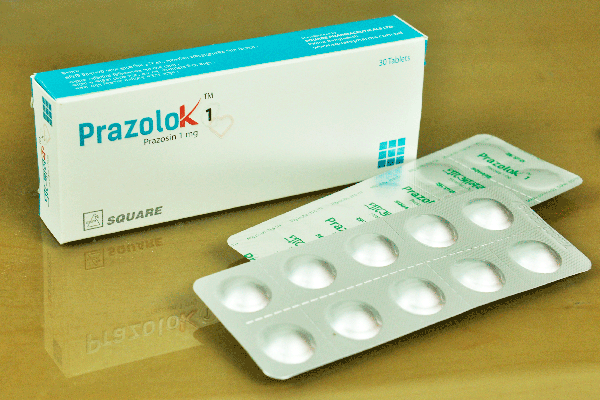
Tablet Prazolok 1 mg
- Brand Name - Prazolok 1
- Generic Name - Prazosin Hydrochloride
- Doges From - Tablet
- Strength - 1 mg
- Pack Size - 30s
- Manufacture - Square Pharmaceutical Ltd.
Customers who bought this item also bought

